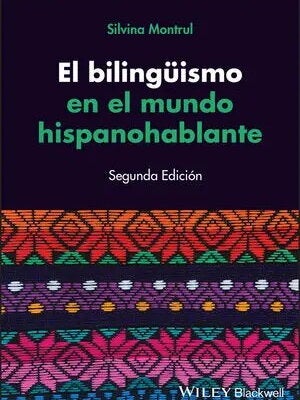
Author: Silvina Montrul
Published January 2026; Wiley - Blackwell
"With an eye for exploring bilingualism within the Spanish-speaking world as an experience governed by sociopolitical and cultural influences, El bilingüismo en el mundo hispanohablante, edicion segunda, offers a careful and thorough overview of the particular characteristics of bilingualism in speakers who use Spanish as a first, second, or other language. Divided into three major sections - bilingualism and society, bilingualism and the individual, and bilingualism and politics and education--this valuable textbook considers bilingualism in the United States, Spain, South America, and Central America to account for the diverse experiences of Spanish speakers in all of the regions of the world in which Spanish is a major language.
The first edition of this textbook was the first work of its kind, offering a focused and concentrated consideration of bilingualism in Spanish, specifically for use in Spanish-language classrooms. Much-loved for its conversational and reader-friendly approach, this book will be updated for the new edition to cover the latest thinking and data on bilingualism and the bilingual advantage debate, bilingualism in school-aged children, and the experience of bilinguals in the Spanish-speaking world who also speak an indigenous language. The new edition will also feature a wholly new chapter on bilingualism and identity and on bilingualism in public life, including a review of the linguistic landscapes of the Spanish-speaking world in art, law, and business. Existing chapters will also be updated throughout to bring references and citations up to date, and to include reference to contemporary popular media, such as film and TV, to promote student comprehension.
An ideal primary text for courses on bilingualism and psycholinguistics, particularly within programs on Spanish linguistics, the new edition of this textbook will stand as an essential work for students in psycholinguistics, sociolinguistics, bilingualism and multilingualism, language education, second language acquisition, heritage language preservation, and Spanish dialectical studies."
-Blurb from Wiley-VCH