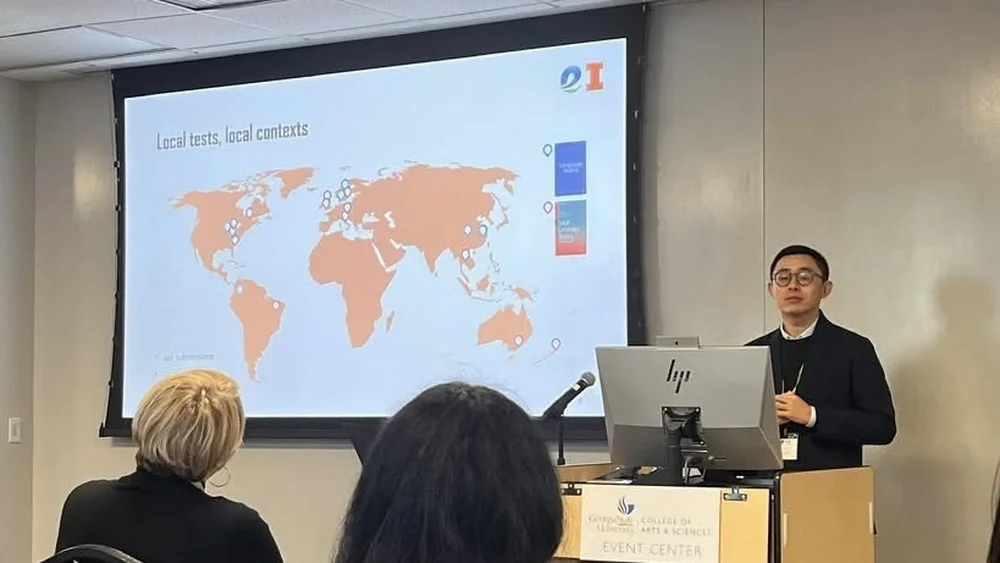
We are pleased to announce that Dr. Xun Yan gave the invited plenary talk at the East Coast Organization of Language Testers (ECOLT) conference.
ECOLT is an organization of professionals and scholars involved in language testing and research. Their goals include supporting connections between academia, K-12 education, government, and for-profit and not-for-profit testing organizations.
At this year's conference, Xun gave the plenary talk, 'Assessment that belongs: The role of local assessment in language programs.' The abstract can be found below:
In educational contexts, language assessments are intended to support teaching and learning, yet the role of assessment in language programs remains less explored (Dimova et al., 2020). Instead, language testing research has predominantly focused on theoretical development, task experimentation, technological innovation, and the validation and use of high-stakes, large-scale assessments. Though rarely acknowledged, the field has favored generalization over contextualization of assessment practice. Even in local language programs, assessments tend to be adopted or adapted from large-scale language assessments. This orientation could be a combination of multiple factors such as the status of large-scale assessments, the availability of local assessment expertise, and the perceived rigor of locally developed assessments.
In this talk, I argue that local assessments are neither informal practice nor a scaled-down version of large-scale assessments. While large-scale assessments offer generalizability, local assessments can develop deeper roots within the communities they serve. Drawing on examples from language programs, I examine how teachers, testers, program administrators, and other stakeholders contribute complementary knowledge and expertise to build locally defensible assessment systems. I argue that such collaboration not only strengthens the relevance, usefulness, and validity of local assessments but also creates sustained opportunities for stakeholders to engage in assessment practice and develop language assessment literacy. In this way, assessment can become part of a community of practice that connects teaching, learning, and program evaluation.
We are excited for this opportunity to share Xun's research!